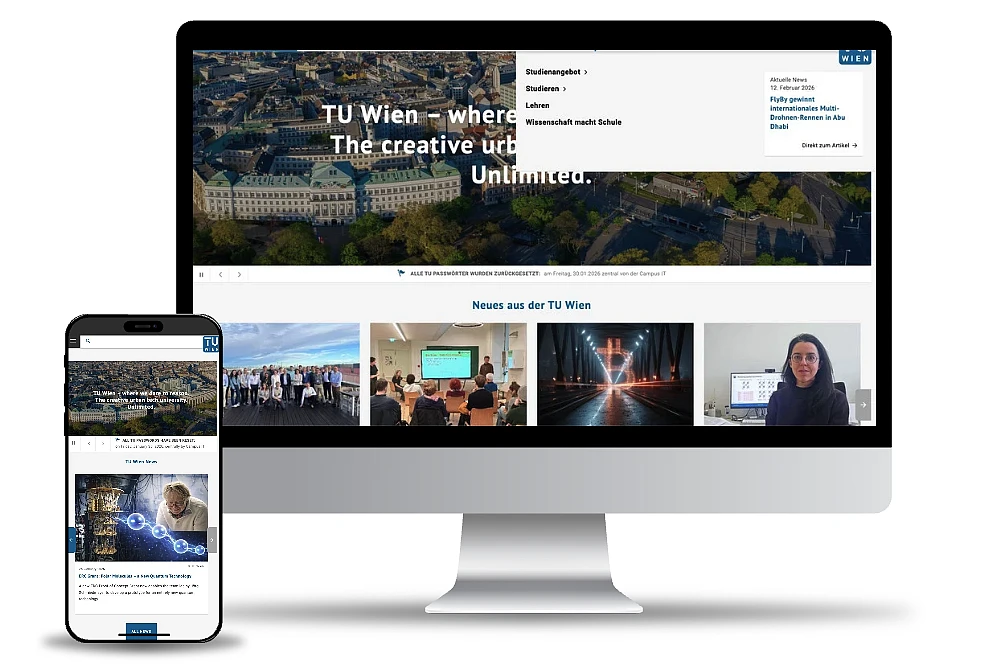

TU Wien Receives a TYPO3 Upgrade Delivering High Performance at Scale
The university unified its digital infrastructure to achieve an editor-friendly, accessible, and scalable platform.

In this article
Are you interested in learning how to reshape your organization's digital presence with TYPO3?
I'm interestedIntroduction
TU Wien is Austria’s largest technical university, with eight faculties, more than 50 degree programs, over 26,000 students, and approximately 6,000 employees. For the university, its website is more than simply a communication channel, it’s an integral part of its digital infrastructure that enables it to deliver information to students, staff, and a wide range of stakeholders. To do so, it requires a scalable, integrated, and accessible solution to support information, services, and university governance. The university has been using TYPO3 since 2005, and is one of the CMS’s foremost educational institutions.
Challenge
TU Wien needed to transform its website into a robust digital infrastructure capable of supporting a decentralized organizational structure with complex requirements. This meant that factors such as high performance, integration with numerous internal systems, accessibility, and decentralized organization were viable and supported. Additionally, hundreds of editors would need to have their work be streamlined and efficient in the website’s backend.
It was a complex project for a large-scale educational institution, but one that aligned strongly with TYPO3’s suitability for similar websites of the same scale, including higher learning institutions, which the CMS specializes in supporting.
Works Performed
The solution was built with TYPO3 as the central platform, as the university had been using the CMS since 2005. The version was upgraded to v12 to enhance its overall functionality and range of capabilities.
The following key additions were made to TU Wien’s digital infrastructure:
- Integration of the campus management system (TISS) to synchronize course, organizational, and staff data.
- Connection to document management system (Alfresco) for structured content access.
- Implementation of ElasticSearch for a powerful search functionality.
- Single sign-on (SSO) integration for secure user authentication.
- Development of custom interfaces to automate data exchange between systems.
- Creation of specialized content elements to meet compliance requirements.
- Continuous performance optimization and system upgrades to ensure scalability.
- Introduction of new features, including AI-supported functionalities.
With regard to the AI-driven developments on the platform, the introduction of artificial intelligence to support TU Wien’s operations includes pilot projects for editorial support using AI, automated translations and integrated accessibility tests.
Outcome
The end result of the project was a scalable, integrated, and accessible digital platform that serves as the digital foundation for the university’s operations. It allows for seamless collaboration across departments and provides a future-proof foundation for ongoing development and innovation through its AI features and automated processes.
Gallery & Features